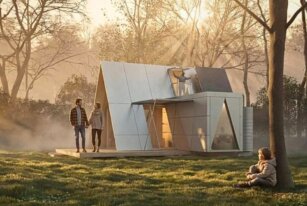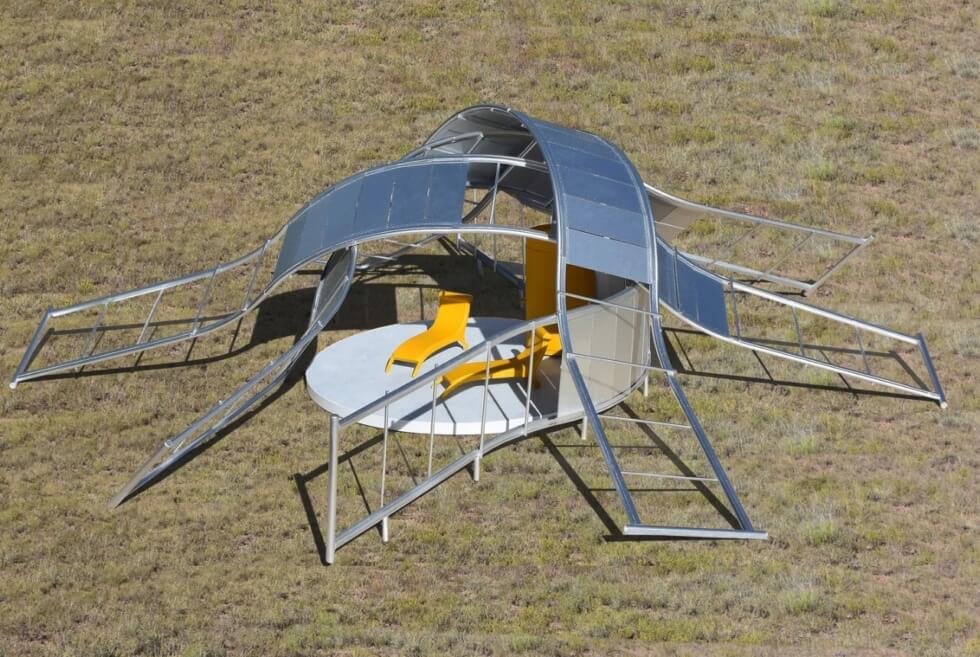
The Interactive Space Pavilion is a conceptual design for a shaded pavilion with articulated joints and movable shutters. Michael Jantzen designed it as a two-person retreat set in New Mexico’s high desert landscape, near Santa Fe. Instead of a fixed canopy, it features modular curved panels that shift positions to change shade coverage.
These panels connect into a free-formed assemblage, each supported by a steel frame. Six hinged solid panels form one large, flexible, solid panel. Meanwhile, four modular curved support frames and eight flexible solid panels make up the canopy. These flexible solid panels can be moved into different configurations using a modified garage door opener.
The support frames move at the touch of a button using small electric motors attached to cables. The articulated design of the panels allows occupants of the Interactive Space Pavilion to adjust the canopy’s coverage according to their comfort or chosen experience. They can move the panels to manipulate light coverage, airflow, privacy, and/or aesthetics.
Occupants can sit on two lounge chairs on a platform under the canopy or store their belongings in the nearby yellow storage pod. They can take shelter from the sun by closing the shutters above them and keeping others open for airflow. They can also form a cocoon for privacy. Occupants can also leave more sections open for expanded views of the surrounding landscape.
Jantzen designed the Interactive Space Pavilion as “a prototype for much larger and more complex structures that explore ways in which the merging of interactive art and architecture can expose new methods.” It explores the possibility of elevating the built environment to new aesthetic and functional heights.
Learn More Here


Images courtesy of Michael Jantzen