So what does an extra $150 actually buy you? Not only a better-looking case, but that’s for sure! On the high-end side of dry herb vaporizers, you’ll be able to invest in better temperature controls, quicker heating, superior battery efficiency, and improved vapor flow design.
The useful question is what changes when you move up a price bracket, and whether those changes affect how you actually use the device.
More precise temperature control
One of the clearest upgrades is better control over heat.
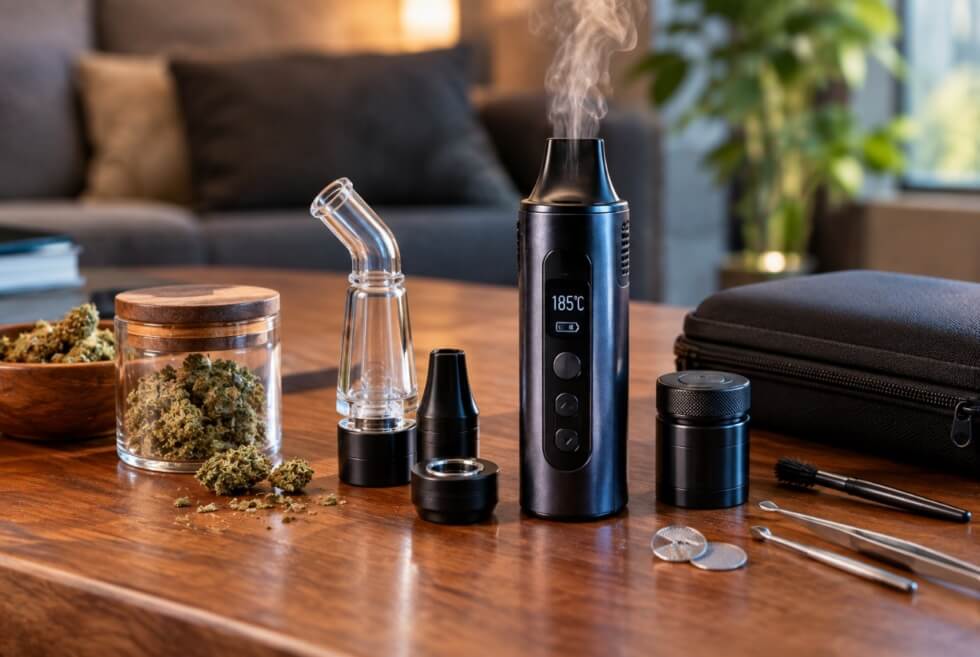
A basic vaporizer may give you a few preset temperatures. A more advanced model can let you choose the temperature much more precisely. For example, the XLUX Roffu offers 1°C adjustments across a 100°C to 220°C range. That means you can make small changes instead of jumping from one preset to another. VapeExperts also notes that it has both session and on-demand modes.
That extra control lets you fine-tune a session instead of accepting whatever preset the device provides.
Faster and more even heating
Spending more can also get you a better heating system.
Convection heating uses hot air to heat the material, while conduction heats it through contact with a hot surface. Some higher-priced devices combine both methods. The point is not simply to have a particular heating label. A well-designed heater should reach the selected temperature quickly and keep the heat more consistent while you draw.
Current models show how far this can go. The Arizer Solo III v2.0 lists a 5 to 15 second heat-up time and uses an 80% convection, 20% conduction heating mix. Arizer also lists 1°C and 10°C temperature adjustments.
You are paying for less waiting and better control, not just a bigger number on the box.
A better battery setup
Battery life is another place where the extra money can make everyday use easier.
Some inexpensive vaporizers have built-in batteries. Once that battery becomes worn, the whole device can become less convenient to use. A model with a removable battery gives you another option: replace the cell rather than replacing the vaporizer.
For example, the Roffu has a 3200 mAh 18650 battery that is replaceable, and users can enjoy about six vaping sessions per charge at moderate temperatures. However, actual use varies with temperature and heating mode.
At a higher price, you may also get faster charging or the ability to use the device while it charges. The Solo III v2.0 supports USB-C PD charging, and Arizer rates it for up to three hours of use per charge.
Better airflow and cooling
This is one of those upgrades you notice while using the vaporizer rather than reading about it.
A better airflow system can make a draw feel less restricted. Better cooling can also make the vapor more comfortable before it reaches your mouth.
Premium devices can take this much further. The Storz & Bickel VENTY has adjustable airflow from 0 to 20 liters per minute and combines conduction and convection heating. Its airflow can be changed with a physical control, so you can adjust how open or restricted the draw feels.
That is a real hardware upgrade, not simply a cosmetic one. You can feel the difference every time you take a draw.
Better materials and vapor paths
Some of the extra $150 can also go into the parts that sit between the heater and your mouth.
Glass, ceramic, zirconia and metal can be used in different parts of the vapor path, depending on the device. Better designs may also make those parts easier to remove and clean.
The Roffu uses a zirconia cooling spiral and offers interchangeable glass and stainless-steel chambers. The glass chamber is designed around clearer flavor, while the stainless-steel option produces denser vapor, according to VapeExperts’ hands-on testing.
This is the kind of upgrade that can make a device feel more refined without adding a flashy feature.
More useful controls and easier daily use
Higher-priced vaporizers often give you more ways to control a session. That can include on-demand heating, session timers, programmable temperature presets, clearer displays, or better controls.
The Solo III v2.0, for example, has both session and on-demand modes, a real-time color display, programmable presets, and a session toggle. Those features do not change what a vaporizer does, but they can make it easier to use exactly how you want.
And that is really what the extra money is buying.
You are not necessarily getting a vaporizer that is dramatically better in every respect. You are paying for fewer compromises: more precise heat, better battery options, quicker heating, improved airflow, better cooling, and controls that are easier to live with.
If your existing hardware performs all the functions you require, then a mere $150 is not going to revolutionize your experience. However, if you have to wait for it to warm up, charge it, fight with its poor airflow, and wish you could have more control, then the additional cost becomes worthwhile.